


To help your child explain their maths thinking, ask one small question about the process rather than requesting a full explanation all at once. Try prompts such as “What did you notice first?”, “Why did you choose that step?” or “What could you check?” Then wait. The aim is to make the reasoning easier to describe—not to turn home practice into an interview.
Why ask about the thinking?
A correct answer tells you that a result was reached. It does not always show which idea or strategy the learner used. A brief explanation can reveal what the child noticed, where a step became unclear, or whether another representation would help.
The US Institute of Education Sciences practice guide for mathematical problem solving in grades 4–8 recommends helping learners monitor and reflect on the problem-solving process, use visual representations, consider multiple strategies, and articulate mathematical concepts. Those recommendations were written for educational settings, so the prompts below are a cautious home adaptation—not a promise that the same routine will suit every child or topic.
Five questions parents can try
1. “What did you notice first?”
This opens with observation rather than correction. Your child might point to a repeated shape, a familiar number, a diagram, or a word in the question. If the answer is brief, ask “Can you show me?” instead of repeating the same question more loudly.
2. “What are you trying to find?”
This checks the goal before focusing on calculations. It can be answered in everyday language. If the question contains several pieces of information, invite your child to circle or point to the part that matters.
3. “Why did you choose that step?”
Use this neutrally, whether the step is correct or not. A calm “why” asks for the connection between the problem and the chosen action. Avoid making it sound like a challenge that must be defended.
4. “Can you show it another way?”
Another way might be a quick sketch, counters, a number line, a different calculation, or a sentence. The IES problem-solving guide specifically discusses visual representations and multiple strategies. The point is not to demand several methods every time; it is to offer another route when one representation is not communicating the idea clearly.
5. “What could you check?”
This keeps ownership of the next move with the learner. Depending on the problem, they might estimate, reverse an operation, compare with an example, or reread the question. If they do not know what to check, offer one concrete option rather than a long list.
Instead of taking over, try a smaller prompt
| Instead of | Try | Purpose |
|---|---|---|
| “That’s wrong.” | “Which step would you check first?” | Points to the process without labelling the learner. |
| “Tell me everything you did.” | “What did you notice first?” | Makes the explanation smaller and more approachable. |
| Giving the next calculation | “What are you trying to find?” | Returns attention to the goal of the problem. |
| “Why don’t you understand?” | “Can you show me where it stopped making sense?” | Locates an unclear step without making a personal judgement. |
| Demanding a spoken answer | “Would you rather point, draw or use the counters?” | Allows more than one way to communicate the idea. |
A short worked-example conversation
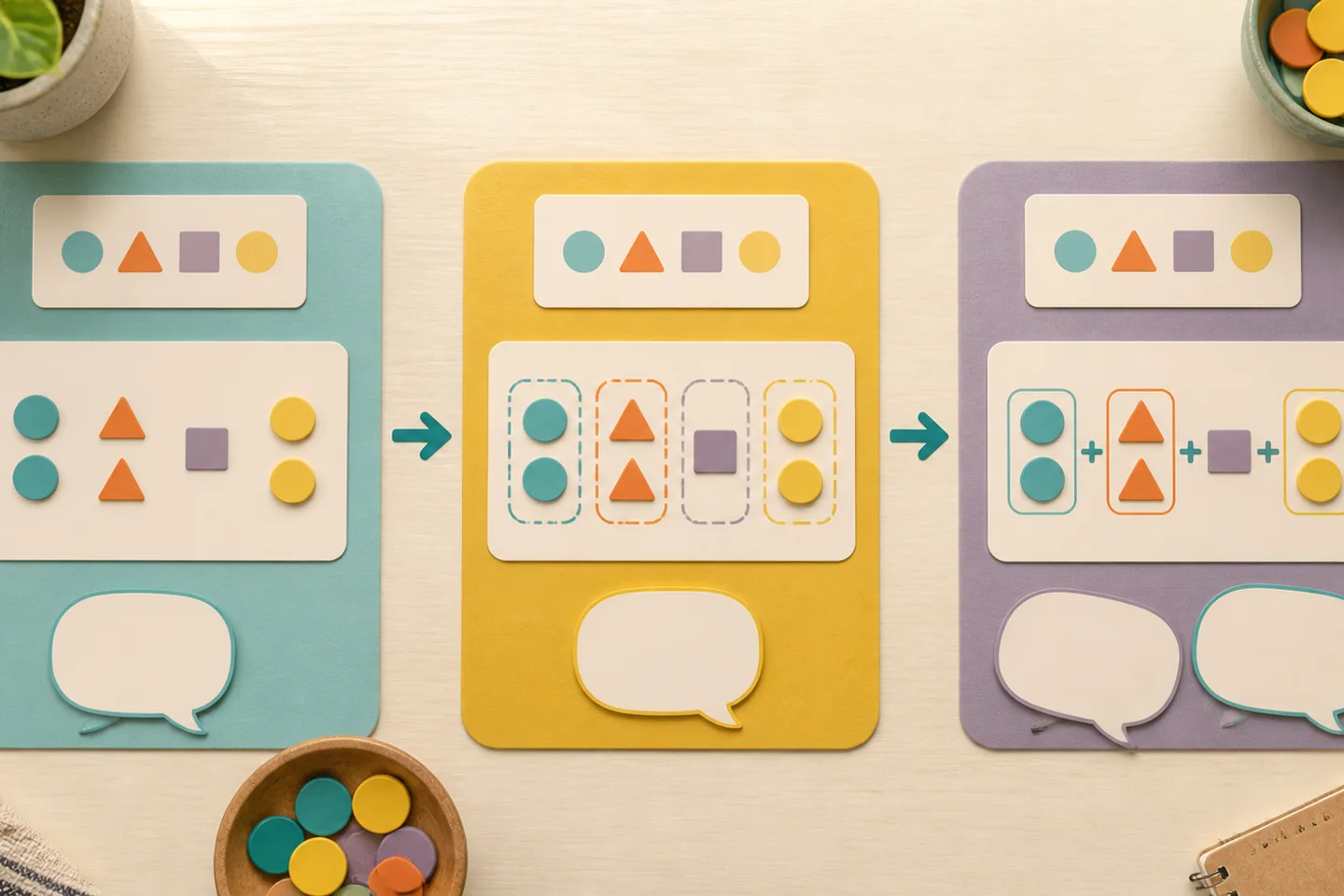
Imagine a fictional problem showing 18 counters split into three equal groups. Your child writes 18 ÷ 3 = 6.
Parent: “What did you notice first?”
Child: “There are three groups.”
Parent: “What are you trying to find?”
Child: “How many are in each group.”
Parent: “How could you check the six?”
Child: “Count six in each group, or do three times six.”
The parent does not ask every possible question. Three prompts are enough to make the goal, method and check visible. If the child had pointed to the groups instead of speaking in full sentences, that could still be a useful explanation.
When your child does not want to explain aloud
Do not force a performance. Offer a choice: point to the important part, draw the next step, arrange counters, select between two possible explanations, or return to the question later. The IES mathematics intervention toolkit for grades 3–6 includes sentence starters, guiding questions and different discussion formats to support mathematical language. At home, the practical lesson is to make communication easier while keeping the prompt specific.
How LearnzyGo can support the conversation
LearnzyGo is an English-language maths practice app for children ages 5–15. Children practise through short learning quests with age-based stages. When an answer is wrong, the app can provide progressive hints and friendly explanations. A parent owns and manages the account and can review progress, completed stages, rewards and settings.
You can use the same small questions alongside a quest: “What did you notice?”, “Which hint connects to your step?” or “What could you check?” Learner profiles are private, and there is no public child social feed.
Frequently asked questions
Does my child need to explain every answer?
No. Choose moments when the method is more useful than the result—for example, a new strategy, an unexpected answer, or a step that feels unclear. Routine questions should stay brief.
What if the explanation is mathematically incorrect?
First find the exact step that differs from the problem or example. Ask what could be checked, then offer one hint if needed. Avoid treating an incorrect explanation as a judgement about the child.
Is pointing or drawing really an explanation?
It can communicate part of the reasoning. Ask the child to connect the pointing or drawing to one short phrase when appropriate, but do not insist on a long spoken account.
What if “why?” makes my child defensive?
Use a less evaluative prompt such as “What did you notice?” or “Can you show me your first step?” Tone and timing matter as much as the wording.
Sources
- Improving Mathematical Problem Solving in Grades 4 Through 8 — Supports monitoring and reflection, visual representations, multiple strategies, and articulating mathematical concepts in grades 4–8 educational settings.
- Assisting Students Struggling with Mathematics in Grades 3–6: Mathematics Intervention Toolkit — Supports carefully scoped discussion of guiding questions, sentence starters, representations, and opportunities to explain mathematical ideas in grades 3–6 intervention settings.
- The effects of metacognitive training versus worked-out examples on students’ mathematical reasoning — Provides reviewed study context for comprehension, connection, strategy, and reflection questions; the article does not claim a guaranteed home-learning effect.