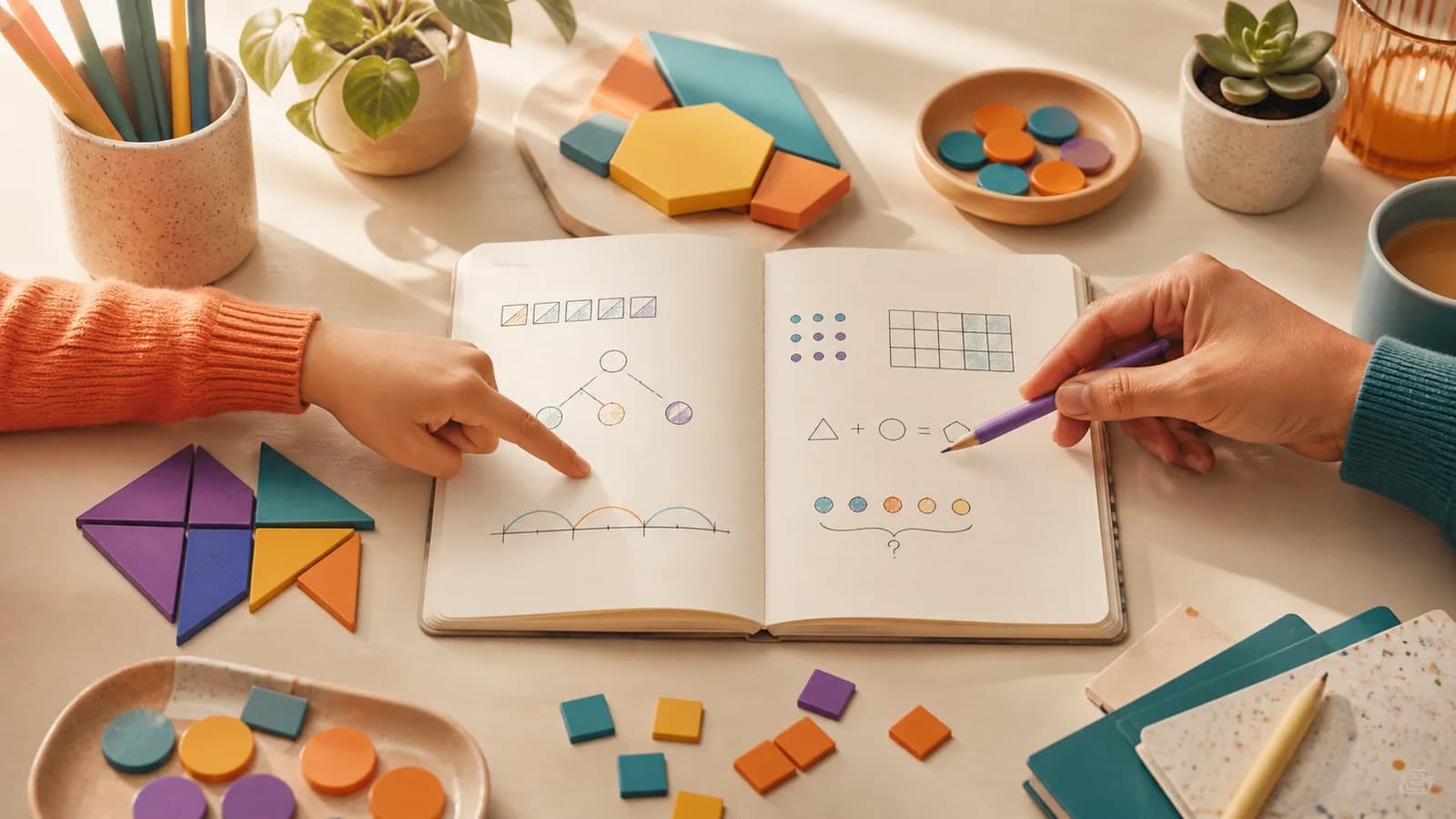


Home maths practice does not need to feel like a second school day. A short session works best when everyone knows what to do, what to try when a step feels unclear, and when the practice will end.
At a glance
- Begin with one familiar idea.
- Look closely at one worked example.
- Try one nearby problem, then stop at the agreed point.
Why a short, predictable routine can help
A routine removes small decisions from the moment. Instead of choosing from a large worksheet or continuing until someone feels frustrated, you can focus on one mathematical idea and one manageable next step.
The US Institute of Education Sciences recommends spacing learning over time, using active retrieval, and alternating worked examples with problem solving. Those principles do not prescribe a single session length, but they support a simple rhythm: remember, examine, then try.
A three-part maths practice rhythm
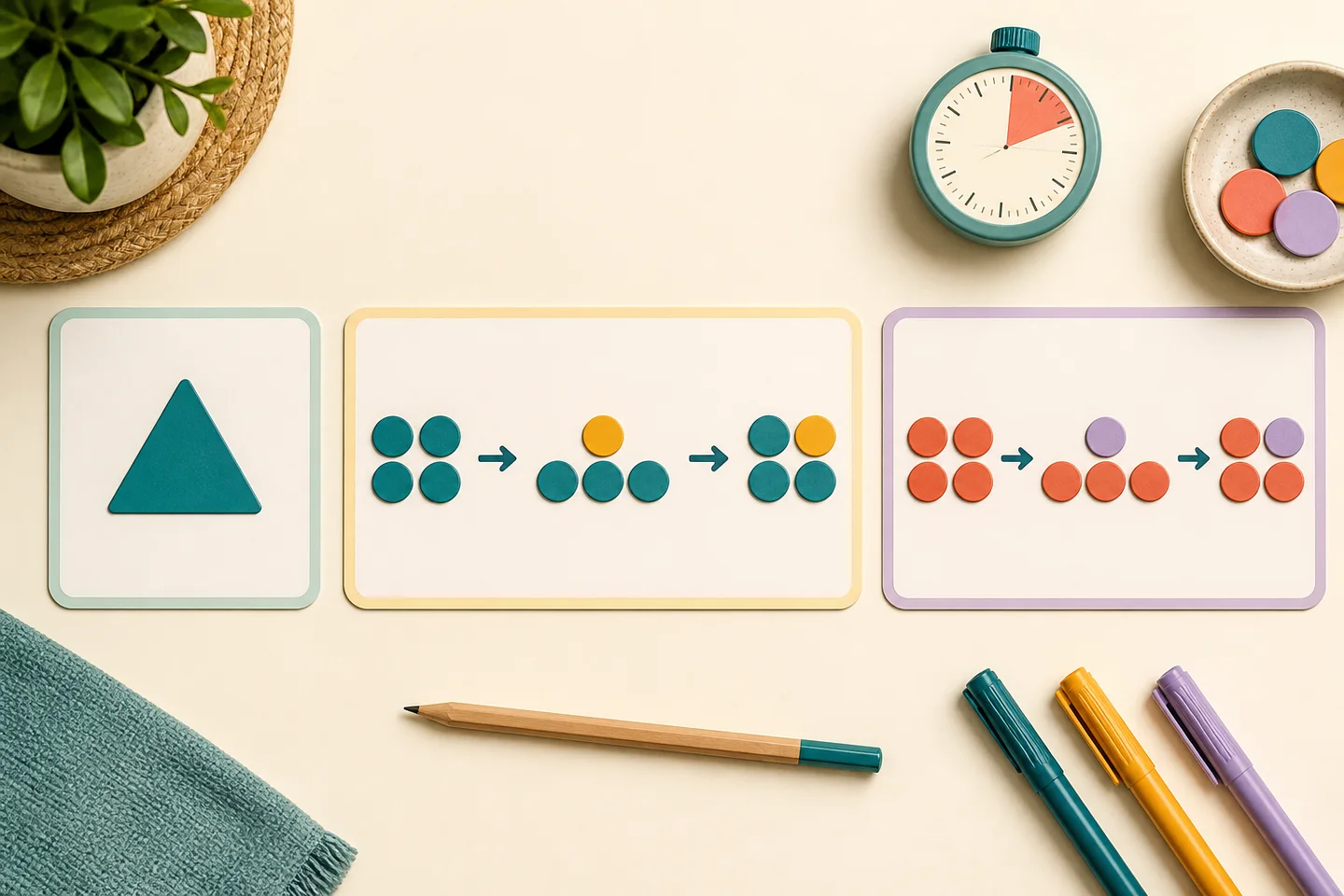
1. Recall one familiar idea
Ask your child to explain, draw, or show something they have already met. Keep the prompt narrow: “What do you remember about this shape?” is easier to approach than “Tell me everything you know about geometry.”
If the answer does not come immediately, offer a small cue rather than turning the moment into a test. The goal is to bring the idea back into view.
2. Look through one worked example
Read each step together. Ask a question such as “Why did this step come next?” or “What changed here?” The conversation should stay on the reasoning, not only the final answer.
If one step is unclear, pause there. Adding more examples before the unclear step makes sense can create more noise rather than more understanding.
3. Try one nearby problem
Choose a problem that uses the same idea with one small change. This gives your child a chance to use the method without suddenly increasing the difficulty.
When the problem is finished—or when you reach the agreed stopping point—name one thing that went well and one idea to revisit later.
| Step | Parent prompt | What to avoid |
|---|---|---|
| Recall | “What feels familiar here?” | Turning recall into a long quiz |
| Examine | “Why does this step come next?” | Rushing past an unclear step |
| Try | “What stays the same in this problem?” | Jumping to a much harder example |
What to do when your child gets stuck
Getting stuck is information. It can show you which step needs another look. Start with the least intrusive support and add more only when it is useful.
- Pause: give your child time to look again.
- Point: identify the exact step that seems unclear.
- Hint: offer one cue connected to the worked example.
- Model: demonstrate the step, then return to a similar problem later.
Avoid stacking several hints at once. One small cue leaves room for the learner to do the next part.
Agree on the stopping point first
A stopping point can be based on time, a single example, or one completed problem. Choose something realistic for the day. When the session ends, resist the temptation to add “just one more” unless everyone genuinely wants to continue.
This is a practical routine, not a promise that one duration will suit every child or every topic. A five-minute session may sometimes be enough; another idea may need to be revisited on a different day.
How LearnzyGo can fit the routine
LearnzyGo is an English-language maths practice app for children ages 5–15. Children practise through short learning quests with age-based stages. The app can provide progressive hints and friendly explanations after a wrong answer.
A parent owns and manages the account, and parents can review progress, completed stages, rewards, and account settings. That makes it possible to keep the child’s practice focused while the adult remains in control of the wider routine.
Frequently asked questions
Does maths practice have to last five minutes?
No. Five minutes is a useful example of a short, bounded session, not a rule. Choose a stopping point that fits the topic and the day.
Should I correct every mistake immediately?
First identify the step that became unclear. A pause, question, or single hint may be more useful than supplying the full answer straight away.
What if the first problem is already frustrating?
Return to something familiar or look at one worked example together. You can also stop and revisit the idea later rather than extending an unproductive session.