

Starting geography practice does not need to mean planning a full lesson or memorising long lists of countries. A manageable routine can be as simple as opening LearnzyGo’s geography practice, choosing the next age-based stage, and giving your child a few calm minutes to answer, think, and try again. The aim is to build a repeatable habit that fits around family life.
LearnzyGo is an English-language maths and geography practice app for children aged 5 to 15. Its geography subject uses short learning quests arranged into age-based stages. When a child answers incorrectly, the app can offer progressive hints and friendly explanations rather than leaving them to guess what went wrong.
Why a small geography routine works well
Geography includes several kinds of knowledge: knowing where places are, understanding what places are like, learning about physical and human processes, and using geographical skills. England’s geography curriculum describes these as connected parts of the subject, including locational knowledge, place knowledge, physical and human geography, and geographical skills. Read the Ofsted geography research review.
That breadth is one reason a short, consistent routine can feel more manageable than trying to cover everything at once. Your child can work through one stage at a time, notice what feels familiar, and return to ideas that need more practice.
There is no need to prescribe one perfect number of minutes. Instead, choose a stopping point that suits your child and your household. A session might end after one quest, after a natural pause, or when concentration starts to fade.
How to begin geography practice in LearnzyGo
1. Start with the stage already in front of your child
LearnzyGo uses age-based stages, so begin with an age-based geography stage that suits your child rather than searching for the hardest topic. The first goal is familiarity with the routine: open the geography subject, read the question carefully, answer independently, and use the explanation if support is needed.
For a younger child, you might sit nearby and help with reading the question without supplying the answer. For an older child, you may prefer to let them work independently and discuss any tricky question afterwards.
2. Treat hints as part of learning, not as a failure
If your child gets an answer wrong, encourage them to pause and use the progressive hint before you step in. A hint can help them identify which part of the question matters, while the friendly explanation can clarify the idea afterwards.
Try saying:
- “What is the question asking you to find?”
- “Which clue could help you narrow it down?”
- “Would you like to try the hint before we talk it through?”
- “What changed between your first answer and the explanation?”
These prompts keep the focus on thinking rather than speed. They also give your child a way to recover from an error without turning one difficult question into a long correction session.
3. Finish with one sentence in your child’s own words
At the end of a quest, ask your child to explain one idea simply. The explanation could be about a place, a map clue, a physical feature, or a word they met in the practice.
Useful prompts include:
- “What is one thing you remember?”
- “How would you explain that to someone younger?”
- “What was easy today?”
- “What would you like to look at again another day?”
Keep this conversation brief. The purpose is to help you see what your child understood, not to turn every practice session into a test.
Adjust the routine for different ages
Children aged 5 to 15 can be practising geography at very different levels. LearnzyGo’s age-based stages provide the structure, while your role can change as your child becomes more independent.
| Age | How to support |
|---|---|
| 5–7 | Read questions aloud when needed and celebrate careful attempts. Ask: “What do you notice first?” |
| 8–11 | Let your child try independently, then discuss one hint or explanation. Ask: “Which clue helped you choose?” |
| 12–15 | Give space for independent practice and invite a short review afterwards. Ask: “What made that answer convincing?” |
These are support ideas, not fixed rules. A confident younger learner may want more independence, while an older child may need you to help them slow down and unpack unfamiliar wording.
A practical geography routine for a busy week
Try this flexible pattern rather than aiming for a perfect schedule:
- Choose a cue. Pick a regular point in the day when geography practice is realistic.
- Open the geography subject. Let your child begin with the next age-based quest or stage.
- Let them think first. Avoid giving clues before they have read the question and made an attempt.
- Use support thoughtfully. Encourage progressive hints and read the friendly explanation together when useful.
- End positively. Ask for one takeaway, then stop while the routine still feels manageable.
- Review progress occasionally. Parents can check progress and completed stages from the parent-managed account.
If a day is too busy, you can skip it without treating the routine as broken. The next session can simply begin with the next available geography quest. A routine that can restart easily is often more practical than one that depends on never missing a day.
Connect app practice with everyday geography
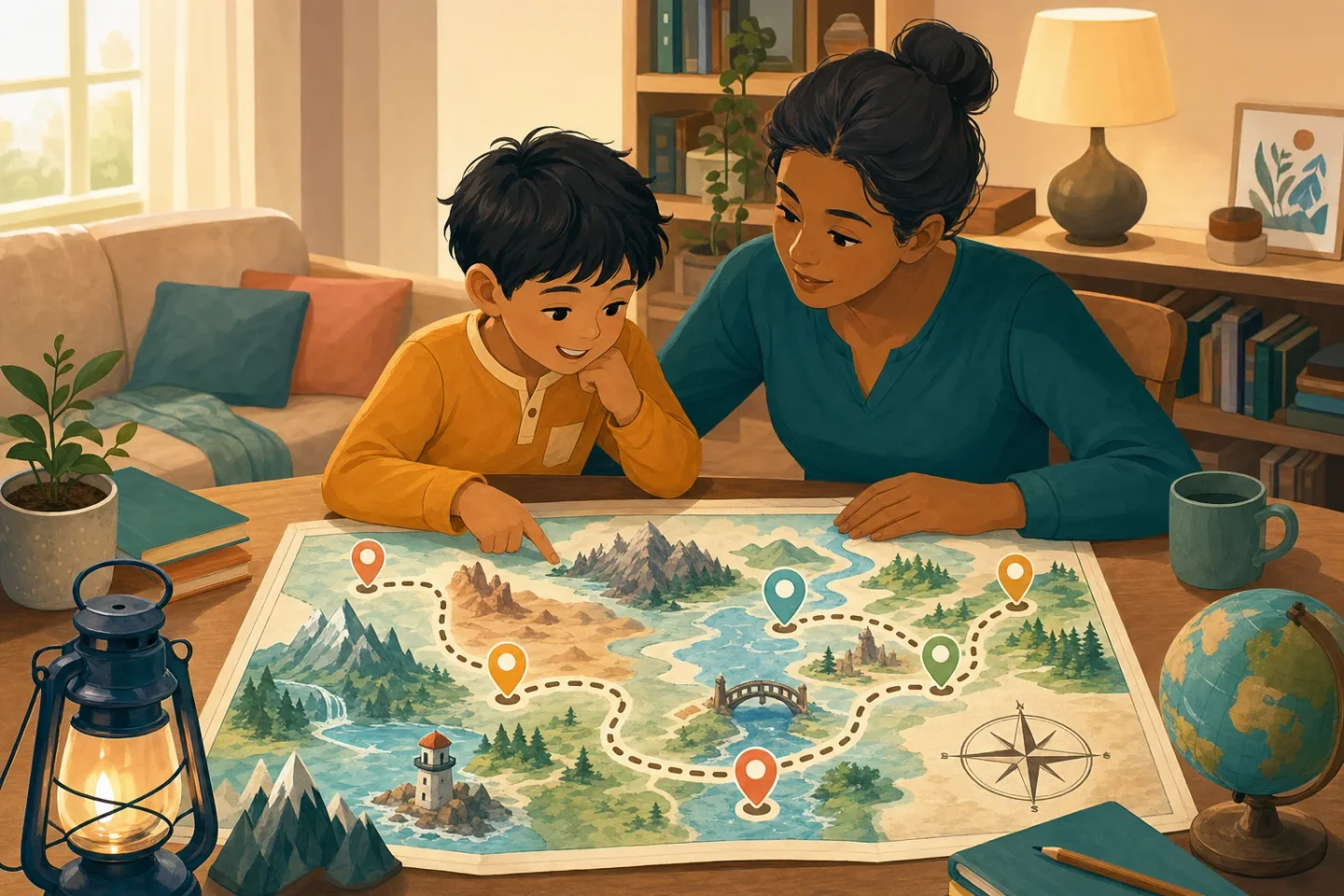
Short conversations outside the app can give geography vocabulary somewhere to go. You might ask your child to describe the route to school, compare two places shown on a map, notice a change in the weather, or identify a physical feature in a picture book or documentary.
Keep these connections informal. For example, while travelling you could ask, “Are we moving north or south?” At home, you could ask, “What makes this place different from where we live?” The English geography curriculum similarly emphasises maps, atlases, globes, directions, places, and physical and human features as foundations for geographical understanding. See the national curriculum geography programme.
These questions do not need to become extra homework. They are simply opportunities to use a word or idea your child has already encountered.
How geography stages fit into LearnzyGo’s adventure
LearnzyGo keeps learning progress and adventure rewards connected. Completing distinct learning stages across subjects can unlock characters, karts, styles, activities, and areas in the in-app adventure game. Stars are never spent.
That means geography practice can contribute to a wider sense of progress alongside other subjects, without requiring your child to use up stars to access rewards. Eligible earned artwork can also be used as kart decals or trophy displays. This article focuses on building a geography routine; the separate adventure guide can explain the wider game experience in more detail.
What parents can monitor
Because the parent owns and manages the account, children do not need their own email address. Parents can review progress, completed stages, rewards, and account settings. Learner profiles are private, with no public child social feed.
Use the progress view as a gentle conversation starter rather than a scoreboard. You might ask, “Which geography stage felt most interesting?” or “Is there a topic you want to revisit?” This keeps attention on the child’s developing understanding and next step.
Frequently asked questions
How often should my child practise geography?
Choose a pattern that fits your family rather than following a fixed ideal duration. A small, repeatable routine can be one geography quest at a time, with flexibility for busy days and breaks.
What should I do when my child gets an answer wrong?
Pause before supplying the answer. Encourage your child to use the progressive hint, read the friendly explanation, and describe what they understand now. One mistake can become a useful point for discussion without turning the session into a correction lesson.
Can geography practice help unlock adventure rewards?
Yes. Completing distinct learning stages across subjects contributes to adventure unlocks, including characters, karts, styles, activities, and areas. Stars are never spent.
Sources
- National curriculum in England: geography programmes of study — Supports descriptions of geography as including locational knowledge, place knowledge, physical and human geography, and geographical skills.
- National Curriculum: Geography key stages 1 to 2 — Supports examples of age-appropriate geography content such as continents, oceans, places, physical and human features, maps, globes, and compass directions.
- Research review series: geography — Supports the explanation that geography learning develops through connected forms of substantive and disciplinary knowledge, including locational, place, process, and geographical skills.